
We work on slabs here that were poured in the seventies and slabs poured last year, sometimes on the same street. They are not the same material and they do not want the same treatment.
Three eras, three kinds of slab
The original General Development lots from the sixties and seventies gave the city its street grid and a lot of modest single storey houses. Those slabs are nearly sixty years old. They are usually sound, often thin by current standards, and many were poured before a vapour barrier underneath was standard practice.
The nineties and two thousands brought the big expansion west and south. Better pours, barriers mostly in place, and now twenty to thirty years of sun and traffic on them.
The newest construction out toward Tradition and the western edge is young concrete that has not finished settling. Hairline cracking in a slab that age is normal and not a defect, but it does mean a rigid finish put on too early will report every bit of that movement.
Why the age of the pour decides the system
An older slab with no vapour barrier moves moisture upward constantly. Seal it and the coating lifts. That slab wants a breathable cementitious system, or a moisture tolerant primer underneath whatever goes on top.
A middle aged slab in good condition is the easiest case and takes almost anything, provided the surface is ground properly first.
A new slab wants either patience or a finish with some flexibility in it, because it is still moving.
You can usually date a slab from the house, and where you cannot, a moisture test settles it.
What this city does to concrete outdoors
Port St. Lucie sits inland of the barrier island, so the salt load is lower than on the beach and the sun and water are what matter.
Afternoon storms through the summer mean standing water on any surface that does not drain, and a driveway with a low spot will show you exactly where it is within a year of being coated. Sprinkler overspray does slower damage in the same way, keeping one patch of a surface permanently damp.
The sun then works on whatever is left. Anything with a standard epoxy topcoat outdoors turns yellow and goes chalky, which is why outdoor work here uses cementitious systems or a polyaspartic topcoat rather than epoxy alone.
The surfaces people ask about most
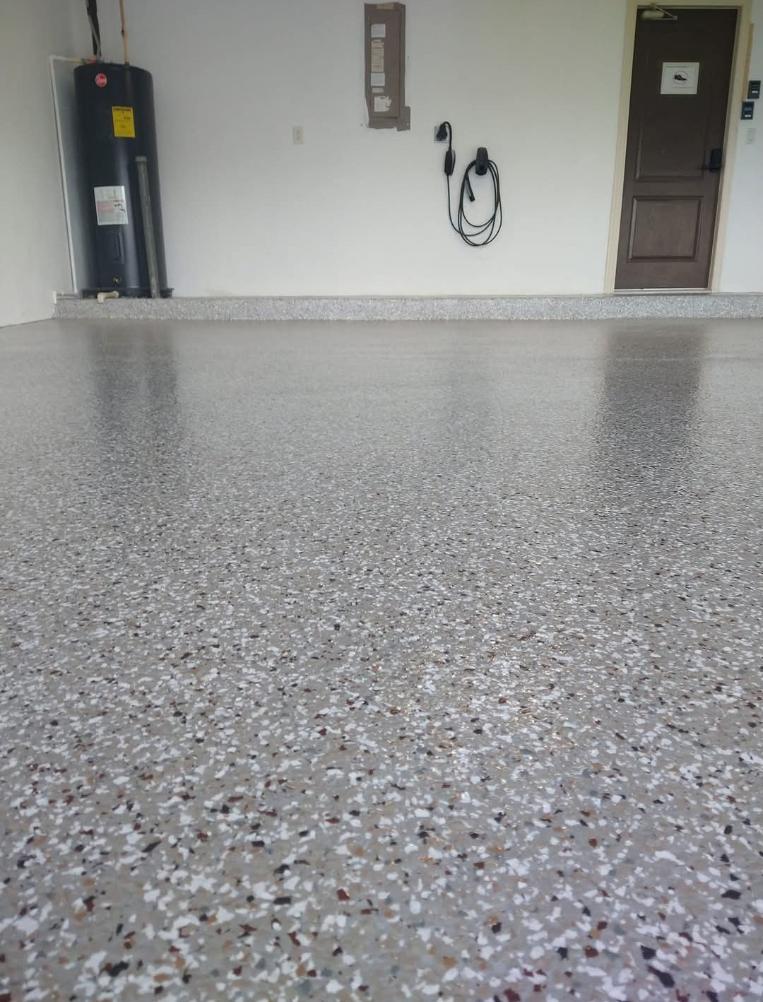
Garage floors come first, almost always flake, and they are the easiest win in the house because the slab is shaded and dry.
Driveways are the biggest visual change and the most demanding surface, because they take vehicle weight and full sun at the same time.
Pool decks and screened lanais are where comfort underfoot and grip when wet matter more than appearance, and where ground moisture turns up most often.
Walkways and entries are small enough to finish in a day and are the piece every visitor walks across before they reach the door.
Port St. Lucie questions
My house is from the seventies. Can the driveway still be coated?
Usually yes. Age by itself is not the problem. What matters is whether the slab is sound, whether it is pushing moisture up from the ground, and whether the surface has spalled. All three are answerable before anyone quotes.
My slab has hairline cracks and the house is nearly new. Is that a problem?
Hairline cracking in young concrete is normal as it cures and settles. It does need handling before a finish goes on, because a rigid coating over a moving crack will split along it.
Can you coat a driveway that holds water after rain?
Yes, and the low spot gets addressed first. A coating does not change where water goes. Standing water on a finished surface works on it continuously, so the drainage is dealt with as part of the job rather than left for later.