People ring up asking for a cement coating and mean four different things. Sorting out which one they want takes about two minutes, and it decides everything that follows.
Four systems, one phrase
A micro-topping is a thin cementitious skim, a few millimetres thick, that renews a sound but tired slab. It does not hide damage and it does not add strength. It gives you a clean, even surface.
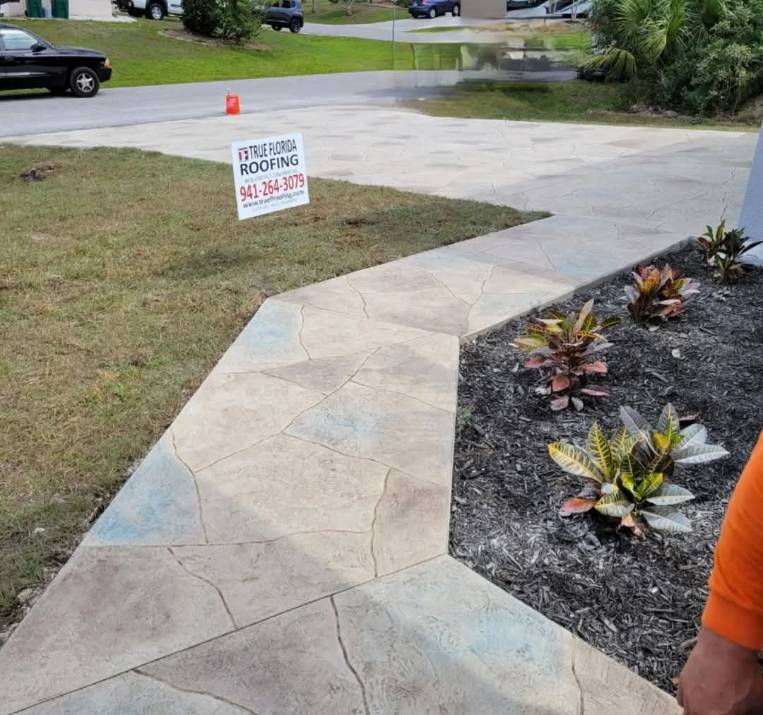
A stamped or textured overlay is thicker and goes on while workable, so it can be pressed with a pattern. This is the one that turns a grey driveway into flagstone or ashlar slate.
A flake or epoxy system is not cement at all. It is a resin coating with vinyl flake broadcast into it, and it belongs on garage floors and interior slabs rather than out in open sun.
A sealer changes nothing about the surface except how it sheds water and how deep the colour reads. It is the cheapest option and often the correct one.
What Stuart does to a slab
Stuart sits between the St Lucie River and the Atlantic, and a slab here deals with salt in the air, afternoon storms through the summer, and sun strong enough to work on a surface most of the year.
The older houses near downtown often sit on slabs poured decades ago, which tend to be sound but weathered. The newer communities west of town have younger concrete that has usually not finished its settling. Those two situations call for different answers, and the age of the house is the first thing worth knowing.
Choose by what the slab is doing
A sound slab with a dull, stained surface takes an overlay well, because an overlay is only ever as good as its grip on what is underneath.
A slab that is spalling, where the top layer is flaking away in patches, needs that failed material taken off and rebuilt before anything decorative goes near it. Coating over spalling buys a season.
A slab with cracks is a different conversation again. A dormant crack can be repaired and coated over. A crack that is still moving will come through any overlay you put on it, so the question is why it is moving before it is what colour you want.
The failure is always at the bond line
When an overlay fails it rarely fails in the middle. It lets go at the edges and at any spot where the old surface was not clean, not sound or not profiled enough to grip.
That is why the preparation takes longer than the decorative work and costs more of the day. Grinding, repairing and cleaning are not what anyone is buying, and they are what decides whether the finish is still there in ten years.
Cement coating questions
Is a cement coating the same as epoxy?
No. A cement coating is a cementitious material troweled or sprayed onto the slab, and it suits outdoor surfaces in full sun. Epoxy is a resin system and it belongs indoors or in a garage. Outdoors, in Florida sun, standard epoxy ambers and chalks.
Can you coat a driveway that already has cracks?
Often, yes, but the cracks are handled first and the handling depends on whether they are still moving. A settled crack is repaired and coated over. A live one has to be understood before it is covered, because it will find its way back to the surface.
How long before we can use it?
Foot traffic is usually next day and vehicles a few days after, with the exact wait depending on the system and the weather. Summer humidity slows curing more than most people expect.