
A coating peels and the obvious conclusion is that somebody used cheap material. Sometimes that is true. Far more often the slab was wet, and no product made will stick to a surface with water pushing out through it.
Water comes up through the slab
Concrete poured on sandy ground with a high water table behaves like a wick. Moisture moves up through it as vapour and leaves through the top surface, every day, whether or not the slab looks dry.
A modern pour has a plastic vapour barrier underneath to stop that. Plenty of older Vero Beach slabs do not, because they were poured before the detail was standard or the sheet was torn during the build. Those slabs push moisture upward for the rest of their lives.
Put a sealed coating on top and the vapour has nowhere to go. Pressure builds at the bond line, and the coating lifts in blisters or lets go in sheets. The material did not fail. It was asked to hold back something it was never meant to.
This is why a slab should be tested before anything is quoted on it. A calcium chloride test or a relative humidity probe takes a day and tells you what you are dealing with. If the reading is high, the answer is a moisture tolerant primer or a breathable cementitious system, not a thicker coat of the same thing.
The island and the mainland are different jobs
Vero Beach sits either side of the Indian River Lagoon, and the two sides are not the same working environment.
On the barrier island, salt arrives constantly on the wind. It settles on every surface, works into porous concrete, and attacks coatings and the steel inside the slab. Anything out there needs a finish that resists chloride and a maintenance habit of rinsing it down.
On the mainland the salt load drops off quickly, and the controlling factors become sun and summer rain. Different problem, different answer, and a contractor who quotes the same system for both is not paying attention.
Matching the system to the surface
A garage floor is indoors, shaded and dry underfoot, which is the one place standard flake epoxy belongs. Add a polyaspartic topcoat if the door stays open and sun reaches the slab.
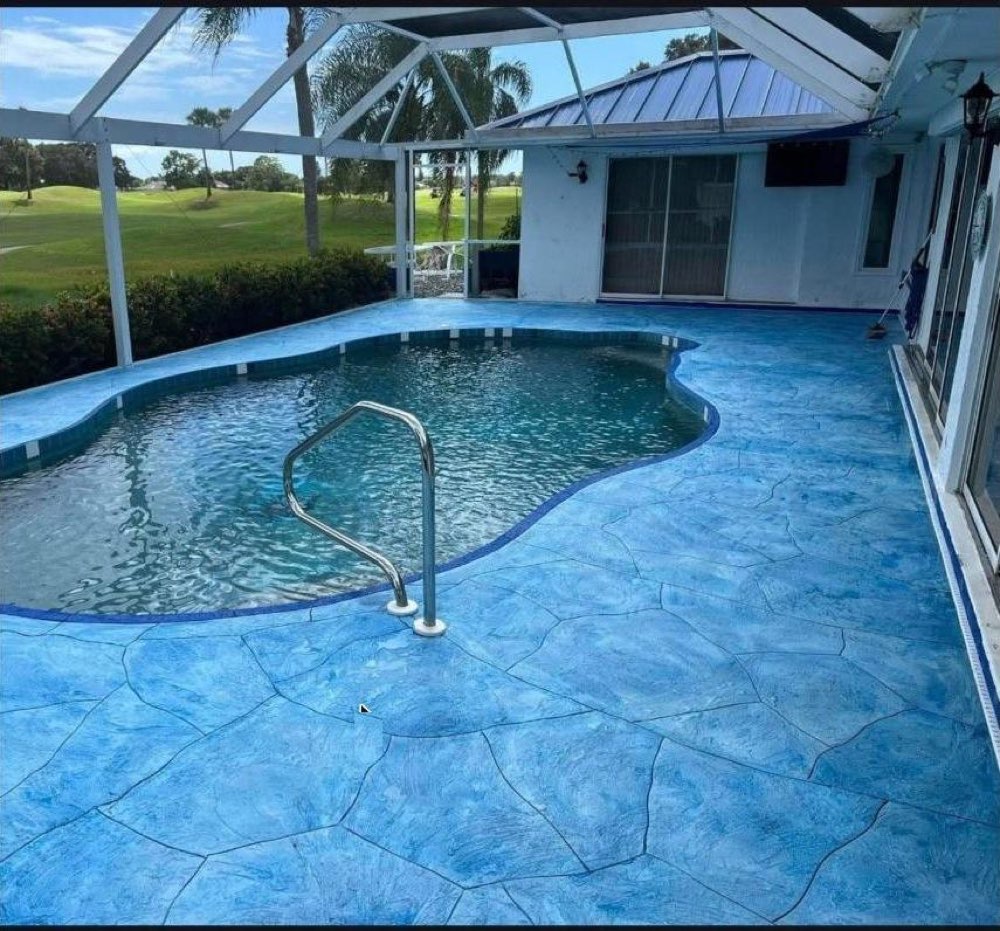
A pool deck has two jobs that fight each other: it has to grip when wet and stay cool enough to walk on barefoot. A textured cementitious overlay in a light colour does both. A dark, smooth coating does neither.
A driveway takes vehicle weight, point loads from jack stands and tyre marks from hot rubber. It wants a cementitious overlay with real thickness rather than a thin film.
A lanai sits under roof but still sees humidity and ground moisture, so it is often the surface where a vapour problem shows up first.
What a quote should tell you
Three things separate a quote worth taking from a number on a card.
It should say how the slab will be prepared, and grinding or shot blasting should appear somewhere in that sentence. Pressure washing alone does not open the surface enough for a coating to key into.
It should say what happens to the cracks and the spalled areas before the finish goes on, priced as its own line rather than folded into a square foot rate.
And on any slab where moisture is a question, it should say whether the slab is being tested. A quote that skips that is a quote that is guessing.
Vero Beach coating questions
Why did my last coating peel?
Usually one of three things: the slab was not ground properly first, the surface was damp when it was coated, or moisture is still rising through the slab from the ground. The third is the most common here and the only one you cannot see by looking.
Will a coated pool deck get too hot?
Not if the colour and texture are chosen for it. Light colours reflect heat and texture breaks up the surface so it holds less of it. Dark, smooth finishes photograph beautifully and are unpleasant to stand on in July.
Do you test the slab before quoting?
On any slab where there is reason to suspect moisture, yes. Older pours without a vapour barrier, anything at ground level that has been damp, and lanais are the usual candidates. It is a day of waiting that saves a failed floor.